
An answer can be almost right and still leave a difficult marking decision. Has the pupil explained enough for the second mark? Would another teacher agree? What should the feedback ask them to do next? Across a class, those decisions take time. AI marking offers to handle some of the repetition: supply the work and criteria, then receive suggested marks and feedback. The useful question is how well those suggestions hold up when the answers become awkward.
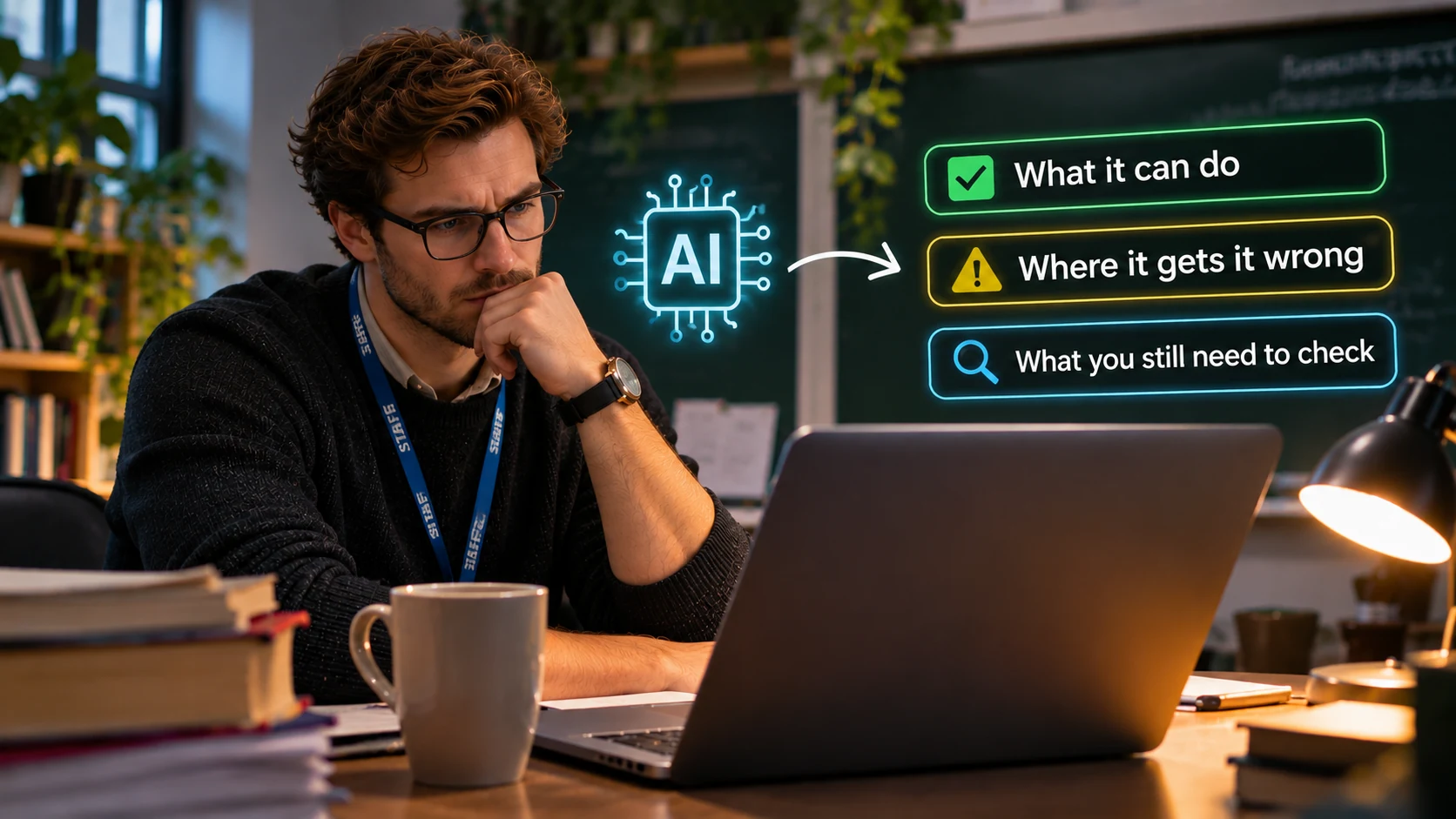
What is AI marking, exactly?
Not every AI marking tool does the same thing. Some systems check straightforward answers against a predefined key. Others interpret written responses, compare them with assessment criteria and suggest marks. More sophisticated tools attempt to judge longer explanations, extended writing and coursework. Those are very different jobs. Checking whether a pupil correctly identifies the capital of France is relatively straightforward. Assessing a six-mark science explanation, where the pupil has some correct knowledge but hasn't connected the ideas properly, is considerably harder.
Then there's an essay. An essay might make a thoughtful argument using unusual language, an unconventional structure or examples the mark scheme doesn't anticipate. It might also sound impressive while saying remarkably little. Teachers learn to recognise those differences. AI systems can sometimes recognise them too, but not consistently enough to be treated as infallible. That's why it's worth asking what kind of marking a tool actually supports before asking how quickly it works.
Where AI marking can genuinely help
Straightforward questions and short answers
AI is particularly useful when the assessment has clearly defined answers or identifiable marking points. Think knowledge-recall questions, short factual responses, simple explanations and classroom quizzes. It can help identify correct answers, organise results and draft individual feedback. The advantage becomes more noticeable when you're working through an entire class. If twenty-seven pupils have correctly identified the function of a plant's roots, writing essentially the same feedback twenty-seven times probably isn't the best use of a teacher's time.
A reliable system can take some of that repetition away. The teacher can then spend more attention on the pupils who misunderstood the concept, gave an unusual answer or need additional support.
Preparing useful feedback
Marking and feedback are related, but they aren't the same thing. A mark tells a student how their work was assessed. Feedback should help them understand what to do next. Consider the difference between:
The second comment gives the student something they can actually work with. AI can help draft this kind of feedback, particularly when it has access to the original answer and the relevant assessment criteria. But the feedback still needs checking. A beautifully written explanation of an incorrect marking decision is not good feedback. The Education Endowment Foundation's guidance on teacher feedback makes an important point: what matters isn't simply how much feedback we provide, but whether it addresses learning gaps and helps pupils improve.
See EEF’s feedback guidance for the underlying principles.
That principle should guide AI-assisted feedback, too.
Noticing patterns across a class
There's another potentially useful application that gets less attention. Imagine marking a Year 10 Business assessment and discovering that half the class can identify an advantage of economies of scale, but struggle to explain how that advantage reduces average costs. That's useful information for planning the next lesson. AI-assisted assessment tools may help organise results and highlight recurring weaknesses. The teacher still needs to check whether the pattern is real and whether it reflects a misunderstanding, poor question wording or something else entirely.
The aim isn't to produce another dashboard for its own sake. It's to make the next teaching decision a little easier.
Where AI marking gets things wrong
AI can explain a decision in confident, convincing language even when the decision is wrong. Teachers need a way to check the reasoning against the actual answer.
1. It can award marks for ideas a student hasn't fully explained
For this illustration, the teacher has specified three one-mark requirements:
- The radiator heats nearby air.
- Heating makes the air expand and become less dense.
- The lower-density air rises relative to cooler, denser air, causing circulation.
The pupil has recognised that the radiator heats the air and that warmer air rises. Under the illustrative requirements above, this answer clearly earns the first mark. It does not explain expansion or reduced density. The third point requires the density difference to explain circulation, so merely saying that air rises does not earn that point either: 1/3 under this particular classroom scheme. An AI system could recognise the right topic and still over-credit the answer. A useful review identifies the missing causal link rather than rewarding familiar vocabulary.
A better assessment would identify exactly which requirements the answer satisfies, which are missing, and why. The feedback might say:
That's much more useful than simply awarding a generous mark. This is an original illustrative classroom question, not an official examination mark scheme. Actual marks must follow the relevant assessment criteria.
2. It can struggle with partial understanding
A student doesn't always give a neatly correct or incorrect answer. They might demonstrate the right idea using unfamiliar wording. They might make a valid point and then contradict it. Or they might explain three things very well while leaving out a crucial fourth. Sometimes a student has the right conclusion for the wrong reason. These are the moments when marking requires particularly careful judgement. AI can recognise many valid paraphrases, but it may also mistake a related phrase for the required explanation.
And a system that marks too generously isn't necessarily doing pupils a favour. If a student receives full marks for an explanation that would lose credit in an examination, they're being given a misleading picture of their understanding.
3. Handwriting and document layout can introduce mistakes
Before AI can judge a handwritten answer, it needs to read it accurately. That isn't always simple. Crossed-out sentences, arrows, mathematical working, annotations, diagrams and answers continued onto another page can create uncertainty. Imagine a pupil writing an incorrect equation, crossing it out and replacing it with the correct one. If a system reads both equations as equally valid parts of the final answer, the marking could be wrong before the assessment even begins.
This is why access to the student's actual original work matters. A teacher should be able to compare the suggested mark with the document that was submitted—not just a tidy transcription produced by software.
4. Longer essays are a different challenge altogether
In May 2026, a Cambridge-led project reported on AI grading of 761 undergraduate psychology essays from 125 students at three UK universities. The systems matched human-awarded broad degree bands in roughly 35–65% of comparisons. That is band agreement, not the percentage of essays receiving exactly the same numerical mark. The researchers also found sensitivity to features such as essay length and linguistic complexity. This was a study of university psychology writing, using particular systems and prompts; it does not establish a GCSE accuracy rate, a Markqo accuracy rate or the performance of every current model.
Research detail: Cambridge’s summary and report explain the dataset and comparison.
For schools, the useful lesson is to demand evidence for the subject, response type and assessment use in question, rather than treating fluent feedback as proof of sound judgement.
What should teachers actually check?
You shouldn't need a computer science degree to evaluate an AI marking tool. Start with five practical questions.
- Does it use my actual mark scheme? A tool that offers generic feedback without understanding the specific marking requirements may miss what the assessment is meant to measure.
- Can I see why a mark was awarded? Look for a clear connection between the pupil's answer, the relevant criterion and the suggested mark.
- Can I inspect the original work? This becomes especially important for handwriting, diagrams, corrections and longer responses.
- Can I correct the mark? Teachers should have meaningful control over the final assessment, rather than being expected to accept an automated decision.
- Does the feedback help the pupil improve? If it merely repeats the mark, offers generic praise or suggests something the pupil already did, it isn't doing much educational work.
Before trusting a new system with an entire class, try a small selection of answers you've already marked: a strong answer, a weak one, a blank response, something partially correct and at least one awkward answer that made you think. Compare the original marking decisions, not just the final marks after a teacher has corrected them. You'll learn far more from those discrepancies than from watching a demonstration where every answer happens to be straightforward.
Can teachers use AI to mark GCSE work?
AI may support some classroom assessment where school policy, safeguarding and data-protection arrangements permit it. Formal qualification work has additional requirements. JCQ’s AI guidance, revised on 20 November 2026, says that where centres allow AI marking support, a human must review the whole work and decide the mark. Its applicable NEA instructions also prohibit AI as the sole or primary means of marking.
For the current wording, read JCQ section 6.
A classroom trial is not permission to use the same arrangement for qualification assessment. Check the current instructions for the particular task. Our companion article explains the differences between homework, mocks and qualification assessment.
And what about student data?
This matters just as much as marking accuracy. Student work may contain names, identifying information, personal circumstances or sensitive information. Uploading it to an unapproved AI service isn't something teachers should do casually. The Department for Education's guidance on AI and data protection advises schools to understand how AI tools use personal data, check that their use complies with school policies and consult their data protection officer or IT lead where appropriate.
Before using a tool, it's reasonable to ask: Where is student work stored? Who can access it? How long is it kept? Is it used to train AI models? Can it be deleted? And does the school have the necessary agreements and safeguards in place? A supplier ought to be able to answer those questions clearly. If the answers are vague, that's a reason to pause.
Will AI marking actually save teachers time?
Potentially, yes. But the useful measure isn't how quickly an AI model produces an answer. It's how long the whole marking job takes. That includes preparing the assessment, supplying the marking criteria, organising student submissions, resolving problems, checking questionable marks and getting useful feedback back to pupils. A system that produces thirty marks in a minute but requires an hour of correcting mistakes hasn't saved an hour. Equally, a tool that handles straightforward responses reliably and allows you to focus on the genuinely difficult ones could make a meaningful difference.
The savings won't be identical across subjects. A short factual science test, a GCSE Business evaluation question and a lengthy English essay place very different demands on a marking system. That's worth remembering whenever a company advertises a single impressive time-saving figure. Ask what kind of work was assessed, how many responses were involved and how much human checking was included.
Where does Markqo fit into this?
Markqo is being developed around teacher-supplied criteria, inspectable suggested judgements and teacher control over approved outcomes. That describes an approach, not a promise of reliable marking for every subject or permission to use the software in any qualification assessment. The checks above apply to Markqo too. Supported work, accuracy, feedback quality and the handling of pupil information need evidence and appropriate school approval. You can explore how Markqo works if you're interested in the approach.
A useful role for teacher judgement
Teachers bring subject knowledge, knowledge of their pupils and an understanding of what an assessment is meant to reveal. Software can assist with parts of the process; it still needs scrutiny. Judge an AI marking tool by the decisions and follow-up it helps you make, as well as the time the whole job takes. The value lies in what teachers and pupils can do with the result.
For the rules governing particular assessments, read Can teachers use AI to mark GCSE work?
For clearer criteria and worked examples, try our guide to creating a good mark scheme
Sources & further reading
- University of Cambridge, ai@cam — Essay-grading research (29 May 2026)
- University of Cambridge — OpRaise report (2026)
- JCQ — AI use in assessments (revised 20 November 2026)
- JCQ — Instructions for conducting non-examination assessments (effective September 2026)
- Ofqual — Principles of AI use in marking (14 January 2026)
- EEF — Teacher Feedback to Improve Pupil Learning (2021)
- DfE — Generative AI and data protection in schools
- Oak National Academy — Explaining convection